We've changed our name to Awareness to Action and moved to awareness2action.org! Please visit us there for up to date information on all of our plans and projects.
You may have also noticed, the Poverty Discussion Blog has been on an unplanned hiatus while we've been getting our new site together. In the future, we won't be adding as much too it as we had in the past, so please check out our new blog that discusses all kinds of global issues, including poverty, at awareness2action.org!
See you there,
Liz
Monday, December 8, 2008

Monday, May 19, 2008
Social Justice and Public Transportation
 Jacob Ohlhausen has been doing work this month on a social justice issue he has noticed in Santa Clara County, California. He isn’t receiving any course credit or financial gain for this project, so I was curious to talk to him about what made him spend time and energy on it. I interviewed Jake on Skype early in May to learn about his project and to see what I could learn about global citizenship and poverty.
He began our interview by explaining “I’m working on a bus paper, which is trying to show that the county of Santa Clara cares more about affluent residents and their needs than lower income residents, and this is shown in the direction they’re going with public transportation developments. Basically, the VTA is trying to create one system for the rich with the light rail, and one system for the poor with the bus and trying to keep them separate. It looks like most of their funds and energy are being directed towards the affluent riders and the light rail. Most of their future construction and plans are concerned with the light rail.
“Rich people use the light rail to commute to work. Some of them park and ride, but primarily the light rail is a power alley through San Jose, from Mountain View to San Jose and Campbell. So its connecting the sort of higher income cities to down town San Jose.”
I asked Jake why poor people didn’t benefit from the light rail. He continued, “I’m not saying they don’t benefit, I’m saying it is a hassle for them to get to the light rail. They’re cutting bus routes. They aren’t really putting any money into the bus. The light rail stops aren’t in convenient places for lower income people. They’re all on Tasman, where the Silicon Valley businesses are, or in down town Mountain View – these are affluent neighborhoods.”
After our carpool broke up when I left the United States, Jake began to take public transportation more frequently. He said he started because “I would be waiting forever for the bus. I was paying a lot of money for the bus. And I just realized how inefficient the bus was. So I decided to start interviewing my fellow riders and keeping travel logs to see if I could notice any trends... to see if what I was seeing was really happening of if I was imagining it. It was really to satisfy my own curiosity.
“The next step had a lot to do with Defrosting Apathy. It provided me with a forum where I could post something. What’s the point of writing something that no one is going to read? I just started collecting the raw data, you know. I was having all these observations while waiting for light rail and busses and doing transfers and things, so I decided to start doing interviews to see if what I was seeing was really happening or if I was imagining it. It was really only to satisfy my own curiosity. I’d notice, well, there’s a lot of Hispanics on the bus today, and only a couple of Asians. I noticed the same thing yesterday. I wonder if there’s a trend. Maybe I should write down the stats every day and see if I notice correlations.
“You were the one who was like ‘well, if you have all this data, you should put it together in a report and then you should put it on Defrost.’”
I think Jake likes to be modest; his mom said he’s always felt bad about class differences, but he said, “it wasn’t like a spark, it wasn’t like bam! I’m going to do something today to go make the world better. Unfortunately, I wish it was, but it wasn’t. You suggested it, when I was collecting the data, I didn’t have a goal in sight other than to make pie charts or graphs. I just thought people were getting a raw deal and it wasn’t right.”
We also talked about Jake’s progress so far and his next steps. He says, “I’ve informed a lot of people I interviewed. I made them aware, and I’ve given them VTA’s website to contact and complain if they want. I don’t know if they’ve done that. I’ve been in contact with a director at the VTA, made him aware of my concerns and the focus of my paper. He’s proved to be interested in my results and helpful in providing me with information. I was pleasantly surprised to find that my concerns – that they are aware of the same concerns I have. The problem is, I don’t really think they care. I feel that a lot of the data I collected they’ve already collected. A lot of our information was very similar, but I feel like they don’t really want to put their resources into making the bus more effective. They want to increase the light rail in size and in areas that they can also develop into communities for higher income residents.”
Jake continued, “this matters because its classism. Its trying to keep the division between rich and poor and keeping them separate from each other. I don’t think it was intentional that it happened this way, but now that they’re aware that this is happening, they’re just allowing the gap to grow larger.”
I asked Jake how VTA could solve this problem. He said, “They could put more resources into the bus. They can just put more financial resources into the bus instead of the pittance they’re putting into it.”
He continued, “this also matters because its not just lower income people. I think its because I lived in New York with the subway system. I want to try to create an overall better system for Santa Clara and San Jose because I think its hopelessly inadequate.”
He also adds, “they’re trying to encourage park and ride. The more you use park and ride, the less you need the bus. Its like they’re trying to make public transportation for people who own cars. And I believe we need to take the car out of the equation. Its ridiculous to… public transportation should be primarily for people who don’t have cars or for people who don’t want to use their car all the time.”
Doing global citizenship in your community? Email me (liz.fleshman@defrostingapathy.org) - we'd love to hear all about it!
(Full disclosure: Jake's my guy. 6/12/2008.)
Wednesday, March 26, 2008
News
 Defrosting Apathy and the Global Poverty Blog are growing at an amazing rate. There are several extremely fantastic things happening that I hope you'll be involved in.
Inspired by Millennium Development Goal #8, "develop global partnerships for development," Defrosting Apathy has forged new partnerships with the student leaders of Silliman University in Dumeguete and the Knowledge for Development Centers (KDCs). KDCs are partnerships between the World Bank and leading private and state universities in the Philippines. As students, we have the power to affect global change. Together, we can create an even bigger impact than we could alone. My hope is to create an international team of students with diverse skills and perspectives. We will discuss one thing we'd like to change, and then design and implement a plan to create that change.
I hope you'll join us! Share your ideas for a better world at defrostapathy.proboards89.com.
I'm really excited about this project. I think once we get rolling, we're really going to be able to do something powerful. I'm sure it will be difficult at first, and we'll have a lot of disagreements - I hope we have a lot of disagreements, but I think we'll all be able to learn important skills and lessons.
That brings me to the Philipinnes. The report from my trip will be available online very soon. I'm waiting for final comments from one last person before it becomes a public document. This has inspired and required an update to the site, but I think its better if you're surprised.
We will also be welcoming two new friends to Defrosting Apathy. Matt Peng, an econ student at San Jose State University, will be translating economics for us. His first article might be about "why economic development?" but Matt has complete creative freedom so maybe he'll change his mind. Joseph Johnen, also a student in San Jose (sorry, I forgot what school), is great at computer stuff. He'll be helping me photoshop all of my awesome Philippines pictures - like with cropping at sharpening and whatever else he thinks should happen.
If you would like to work on Defrosting Apathy, please email me - if you have your own idea that would be cool, or you could do something on my list of things to get around to, which would also be nice, as I am living a double life.
(Edited March 27, 2008 for crazy formatting issues. Mac and Google hate each other now, and its so inconvenient.)
Saturday, January 26, 2008
Some Water Issues
I will be going to the Philippines Tuesday as a short-term consultant with the World Bank! It will be my job to document some of what the World Bank is doing and how it impacts people on a local level, giving the issues a human voice and perspective. It should be very interesting, and I'm creating a new section of Defrosting Apathy to share it with you. In the meantime, I've been getting a lot of travel advice. The thing everyone seems to say is not to drink the water.
At first "why not?" seemed like a stupid question. Further, is there a "Washington's Revenge?" - Do people in other parts of the world have trouble drinking my water? I also wondered, do locals drink the water? Do they suffer as a result, or have they built up an immunity to the bugs that live in it? Does it hold back the Global South? Can something be done, like creating more infrastructure?
Up to Date Patient Information: General Travel Advice says travelers can get infectious diarrhea (traveler's diarrhea), hepatitas A, and trichnellosis. They also say don't drink, make ice cubes with, or brush the teeth with local water. Drink boiled tap water. Don't eat unpeeled fruit or raw vegetables. I knew most of this -Thomas Mann's character Aschenbach died as a result of eating the strawberries that represented the lure of the Global South.
The Center for Disease Control discusses the science behind traveler's diarrhea, and the implication is that the traveler should be wary, but not the local. They also include an unsurprising map: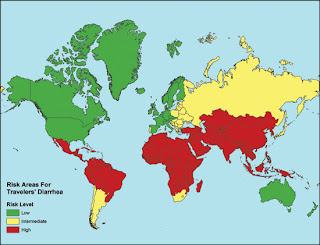
I even attended a meeting for travelers (my Austria trip looms as well), in which a local health official laughingly made reference to "Montezuma's Revenge." I've since had a change to discuss it with the hosts of the meeting, who agreed that "ha ha ha, we can't drink their water because they're poor" was inappropriate.
At first "why not?" seemed like a stupid question. Further, is there a "Washington's Revenge?" - Do people in other parts of the world have trouble drinking my water? I also wondered, do locals drink the water? Do they suffer as a result, or have they built up an immunity to the bugs that live in it? Does it hold back the Global South? Can something be done, like creating more infrastructure?
Up to Date Patient Information: General Travel Advice says travelers can get infectious diarrhea (traveler's diarrhea), hepatitas A, and trichnellosis. They also say don't drink, make ice cubes with, or brush the teeth with local water. Drink boiled tap water. Don't eat unpeeled fruit or raw vegetables. I knew most of this -Thomas Mann's character Aschenbach died as a result of eating the strawberries that represented the lure of the Global South.
The Center for Disease Control discusses the science behind traveler's diarrhea, and the implication is that the traveler should be wary, but not the local. They also include an unsurprising map:
Focusing on travel diarrhea implies that its a travel issue, that in fact locals are able to adapt to non-potable water. However, UN Millennium Development Goal #7, ensure environmental sustainability, includes a stated goal to reduce by half the number of people living without sustainable access to clean drinking water.
The World Health Organization notes some interesting H2O statistics in a fact file:
- 4 in 10 people globally live without access to clean drinking water. This is "getting worse because of population growth, urbanization and an increase in domestic and industrial use."
-By 2025, 2 billion people will live with a water shortage.
- The WHO recommends a level of 500 cubic metres of water per person per year, for healthy and hygienic living.
- Water scarcity means people rely on unsafe sources of drinking water.
- "Poor water quality can increase the risk of diarrhoeal diseases including cholera, thyphoid fever, salmonellosis, other gastrointestinal viruses, and dysentery. Water scarcity may also lead to diseases such as trachnoma, plague and typhus. Trachnoma, for example, is strongly related to a lack of water for regular face washing."
- "Water scarcity encourages people to store water in their homes. This can increase the risk of household water contamination and provide breeding grounds for mosquitoes - which are vectors for dengue, dengue haemorrhagic fever, and malaria and other diseases."
- Good water management reduces breeding sites for disease vectors, reducing disease.
So to answer some of my earlier questions, no, I can't drink the water there. People who come to the US don't face issues with our water, despite what the government of San Jose is having difficulty realizing. Locals really shouldn't drink the water there either, but they have to. There is no immunity, it does hold back the Global South, and something can be done. However, there is not enough water to go around, so it will become increasingly difficult to keep what we do have clean.
The answers raise an important new question: how do you live and care for your family without clean drinking water?
Friday, December 28, 2007
Visited the Dump Today
My friends were taking stuff to the dump today, and I decided to tag along. I had piled up some stuff thinking I'd use it again some day, but after months and years I realized it was time to clear it out. I felt guilty at first because it seemed wasteful and I hate the idea of sending things to a landfill, but then I realized that wasn't a good reason to turn my house into a landfill either. Next time, I'll try to buy stuff that will last longer - for example, we tossed out a mop without a removable mop head. A smarter purchase would have let us reuse most of it.
Anyway, it was a great chance to see what happens to stuff when we're done with it. Apparently, photography isn't allowed at the public dump, so I have blurred out a lot of identifiable information about which dump it is and so on.
Here are my three favorites:


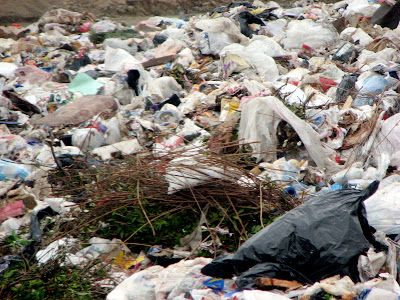
If you want to see more of my illicit dump photography, check out my album.
Anyway, it was a great chance to see what happens to stuff when we're done with it. Apparently, photography isn't allowed at the public dump, so I have blurred out a lot of identifiable information about which dump it is and so on.
Here are my three favorites:
If you want to see more of my illicit dump photography, check out my album.
 |
| At the Dump |
Tuesday, December 18, 2007
The Relationship Between the Core and Periphery
I was talking to Drs. Reckmeyer and Fried the other night about the gap between the core and periphery countries. One of the things Reck always says is that we need to close the gap between the two groups for humanitarian and security reasons. Dr. Fried pointed out that in any arrangement, the core needs the periphery to be more inventive, while the periphery needs the core to hold on to traditional approaches, so that there can be realistic give and take between change and stability.
So, I was reading the internet like my grandfather must have read his morning newspaper when I came across this essay about how to improve Manila by Patricia Faustino.
I thought this was a really great thing. The World Bank had an essay contest about improving a city. Local people responded with great ideas. These ideas are on the internet for me, and presumably for the agents in the Philippines with the power to make a difference, to think about. Maybe knowing the international community is listening to these ideas will further affect them.
But more than that, I think Faustino's essay connects to what we were talking about the other night. And what Hash wrote about here in response to an article saying Africans don't need or deserve computers. His response to the rest of his community was, "Try this on for size: as an African, you are more of an expert on what your part of Africa needs than any self-prescribed expert from the west." Bill Thompson even wrote a thoughtful response, agreeing with Hash about the need for Africans to speak for Africa.
Its not just that peripheral solutions are better for peripheral problems because its a convenient way of avoiding personal responsibility. Certainly, I don't have the tools or the experience to know what a child in southeast Asia or sub-Saharan Africa needs or wants. But its not like we're all so different that if it came down to it, I couldn't come up with some ideas, however culturally inappropriate.
Really, they're better because they demonstrate who is responsible for the community. If a western construction crew showed up and built everything before Faustino had a chance to imagine it, it would be very unsatisfying. Winning a World Bank essay contest is far more fulfilling to the individual and community. Had the construction crew simply showed up, no one would have bought into the idea of public space, which would have then perhaps been destroyed. And, it would have pissed off well-intentioned donors in the west. Faustino's point about how important it is for citizens of Manila to imagine a better world is really well put.
Moreover, the core needs these frontier ideas in and of themselves. Not for humanitarian reasons or to empower the voiceless, but for the genuine betterment of everyone. These problems challenge core communities to put their best efforts towards something other than stagnation and decadence.
So, I was reading the internet like my grandfather must have read his morning newspaper when I came across this essay about how to improve Manila by Patricia Faustino.
I thought this was a really great thing. The World Bank had an essay contest about improving a city. Local people responded with great ideas. These ideas are on the internet for me, and presumably for the agents in the Philippines with the power to make a difference, to think about. Maybe knowing the international community is listening to these ideas will further affect them.
But more than that, I think Faustino's essay connects to what we were talking about the other night. And what Hash wrote about here in response to an article saying Africans don't need or deserve computers. His response to the rest of his community was, "Try this on for size: as an African, you are more of an expert on what your part of Africa needs than any self-prescribed expert from the west." Bill Thompson even wrote a thoughtful response, agreeing with Hash about the need for Africans to speak for Africa.
Its not just that peripheral solutions are better for peripheral problems because its a convenient way of avoiding personal responsibility. Certainly, I don't have the tools or the experience to know what a child in southeast Asia or sub-Saharan Africa needs or wants. But its not like we're all so different that if it came down to it, I couldn't come up with some ideas, however culturally inappropriate.
Really, they're better because they demonstrate who is responsible for the community. If a western construction crew showed up and built everything before Faustino had a chance to imagine it, it would be very unsatisfying. Winning a World Bank essay contest is far more fulfilling to the individual and community. Had the construction crew simply showed up, no one would have bought into the idea of public space, which would have then perhaps been destroyed. And, it would have pissed off well-intentioned donors in the west. Faustino's point about how important it is for citizens of Manila to imagine a better world is really well put.
Moreover, the core needs these frontier ideas in and of themselves. Not for humanitarian reasons or to empower the voiceless, but for the genuine betterment of everyone. These problems challenge core communities to put their best efforts towards something other than stagnation and decadence.
Wednesday, December 12, 2007
Nobel Lecture - Doris Lessing
Doris Lessing's Nobel Lecture was beautiful and important. There is really nothing to add.
Sunday, December 9, 2007
A New Kind of Toilets Help Malawi
These are pretty cool. They're toilets deisgned to convert human waste into compost. They're designed for hygenic practice, environmental soundness and resource preservation. Further, the authors note the technology is appropriate in Malawi because people will occasionally plant trees on former pit latrines. It is gaining popularity in Malawi and in Madagascar, although the authors are careful to note that their product does not suit everybody. But I think these will come in handy - maybe they'll think about building them at schools, since we always hear about how schools need toilets so girls can attend without getting sick.
Saturday, December 8, 2007
Beyond the Headless Heart: Accepting Complexity
I'm reading The Bottom Billion by Paul Collier. I wanted to share the following bit for two reasons. First, I'm excited that more smart people are on board with the whole complex, systemic issue thing. Its all well and good for me to parrot that; in fact its really important since I hope that through discussion and understanding we can put pressure on politicians to get to working on these issues the right way. But like we need to understand that it's complicated, we also need to know what to do about it. And that's really where professors from Oxford and the like can do their part.
I wanted to share the following bit for two reasons. First, I'm excited that more smart people are on board with the whole complex, systemic issue thing. Its all well and good for me to parrot that; in fact its really important since I hope that through discussion and understanding we can put pressure on politicians to get to working on these issues the right way. But like we need to understand that it's complicated, we also need to know what to do about it. And that's really where professors from Oxford and the like can do their part.The passage (and book) also contradicts one of Dr. Reckmeyer's big points. He asserts that by assisting the developing core, like China and India first, we'll all be in a better position to assist everyone else. Collier points out (slightly earlier in the book) that the global market is becoming too hostile for that to be a good idea. So, we have some spark for a discussion.
The problem of the bottom billion is serious, but fixable. it is much less daunting than the dramatic problems that were overcome in the twentieth century; disease, fascism, and communism. But like most serious problems, it is complicated. Change is going to have to come from within the societies of the bottom billion, but our own policies could make these efforts more likely to succeed, and so more likely to be undertaken.
We will need a range of policy instruments to encourage the countries of the bottom billion to take steps toward change. To date we have used these instruments badly, so there is a considerable scope for improvement. The main challenge is not that these policy tools span various government agencies, which are not always inclined to cooperate. Traditionally, the development as been assigned to aid agencies, which are low in almost every government's pecking order. The U.S. Department of Defense is not going to take advice from that country's Agency for International Development. The British Department of Trade and Industry is not going to listen to the Department for International Development. To make a development policy coherent will require what is termed a "whole-of-government" approach. To get this degree of coordination requires heads of government to focus on the problem. And because success depends on more than just what the United States or any other nation does on its own, it will require joint action across major governments.
The only forum where heads of the major governments routinely meet is the G8. Addressing the problem of the bottom billion is an ideal topic for the G8, but it means using the full range of available policies and so going beyond the Gleneagles agenda of 2005, which was a pledge to double aid programs. Africa is already back on the G8 meeting in Germany. "Africa+" should rightly stay on the G8 agenda until the bottom billion are decisively freed from the development traps. This book sends out an agenda for the G8 that would be effective (pp. 12-13).
So here goes:
Beyond the Headless Heart: Accepting Complexity
The problem of the bottom billion is serious, but fixable. it is much less daunting than the dramatic problems that were overcome in the twentieth century; disease, fascism, and communism. But like most serious problems, it is complicated. Change is going to have to come from within the societies of the bottom billion, but our own policies could make these efforts more likely to succeed, and so more likely to be undertaken.
We will need a range of policy instruments to encourage the countries of the bottom billion to take steps toward change. To date we have used these instruments badly, so there is a considerable scope for improvement. The main challenge is not that these policy tools span various government agencies, which are not always inclined to cooperate. Traditionally, the development as been assigned to aid agencies, which are low in almost every government's pecking order. The U.S. Department of Defense is not going to take advice from that country's Agency for International Development. The British Department of Trade and Industry is not going to listen to the Department for International Development. To make a development policy coherent will require what is termed a "whole-of-government" approach. To get this degree of coordination requires heads of government to focus on the problem. And because success depends on more than just what the United States or any other nation does on its own, it will require joint action across major governments.
The only forum where heads of the major governments routinely meet is the G8. Addressing the problem of the bottom billion is an ideal topic for the G8, but it means using the full range of available policies and so going beyond the Gleneagles agenda of 2005, which was a pledge to double aid programs. Africa is already back on the G8 meeting in Germany. "Africa+" should rightly stay on the G8 agenda until the bottom billion are decisively freed from the development traps. This book
sends out an agenda for the G8 that would be effective (pp. 12-13).Tuesday, December 4, 2007
Defrosting Apathy
Yesterday, I presented my new website Defrosting Apathy in class. I've been creating it tangentially with this blog to discuss systems theory concepts in the context of global action. I'm really happy with how its turned out so far, although my webmaster and I still plan to add more content at the end, some visual enhancements and a few technological upgrades that will support the site in the future. I've also decided to publish a quarterly newsletter, so eventually the site should have an email sign up doodad. (In the meantime, if you'd like to receive my awesome newsletter, you can email me at liz.fleshman at defrostingapathy.org).
How cool is that? I have an email addy @defrostingapathy.org!
How cool is that? I have an email addy @defrostingapathy.org!
Monday, November 26, 2007
African Artists Community Development Project - Buying crafts from African Artists to fund local African Children's Aid Organizations.
I am back from my Thanksgiving trip - its always been my favorite holiday! We visited my boyfriend's mother at her home on Martha's Vineyard, sort of around the corner where the Pilgrims learned how to survive from the Native Americans.
While we were there, Marsha Winsyrg, a friend of Ruth's, was showing a short documentary she and her daughter created for their organization AACDP - African Artists Community Development Project. They buy crafts from (women!) artists in Zambia, sell their crafts in the US, and then donate the money they make to an orphanage and a center for disabled children.
At the end of the film, Marsha said, more eloquently, that she thought her role in the US was to:
1) act as facilitators between all parties
2) to support AIDs R&D in the US
3)
I don't remember #3... Suffice it to say, she had a great sense of what was the right role for her and her organization, which allows them to support local ideas and projects. Further their solutions touch other global problems - transportation, AIDs, education, etc. - but they keep their solution realistically sized so that they don't create a systemic mess.
While we were there, Marsha Winsyrg, a friend of Ruth's, was showing a short documentary she and her daughter created for their organization AACDP - African Artists Community Development Project. They buy crafts from (women!) artists in Zambia, sell their crafts in the US, and then donate the money they make to an orphanage and a center for disabled children.
At the end of the film, Marsha said, more eloquently, that she thought her role in the US was to:
1) act as facilitators between all parties
2) to support AIDs R&D in the US
3)
I don't remember #3... Suffice it to say, she had a great sense of what was the right role for her and her organization, which allows them to support local ideas and projects. Further their solutions touch other global problems - transportation, AIDs, education, etc. - but they keep their solution realistically sized so that they don't create a systemic mess.
Tuesday, November 13, 2007
Ship Breaking
Dr. Hopkins made a reference to single-hulled ships ditched in Bangladesh, which are being broken down by people with no other options. He showed pictures from a photographer, Edward Burtynsky. Here is a link to his website.
Greenpeace has been active in this area as well. Here is an article that asserts "the current practice of sending EU+ toxic old ships to developing countries is a carefully disguised form of the hazardous waste trade...It is clear that the EU+ has not only an enormous responsibility but an opportunity to bring the shipping industry into line with the norms of international guidelines on the transboundary trade in toxic waste. The EU+ cannot, on either legal or moral grounds, protect its beaches and environment from oil spills by exporting the threat to Asia and Turkey. There is an urgent need for shipbreaking facilities that can deal with the inherent legacy of toxics."
I also found this article, which calls for exporting greener, less toxic ways of scrapping to places like Bangladesh, India and Turkey because the steel claimed from these ships is important to local economies.
We really need to think these kinds of ideas all the way through.
(April 8, 2008, updated links).
Greenpeace has been active in this area as well. Here is an article that asserts "the current practice of sending EU+ toxic old ships to developing countries is a carefully disguised form of the hazardous waste trade...It is clear that the EU+ has not only an enormous responsibility but an opportunity to bring the shipping industry into line with the norms of international guidelines on the transboundary trade in toxic waste. The EU+ cannot, on either legal or moral grounds, protect its beaches and environment from oil spills by exporting the threat to Asia and Turkey. There is an urgent need for shipbreaking facilities that can deal with the inherent legacy of toxics."
I also found this article, which calls for exporting greener, less toxic ways of scrapping to places like Bangladesh, India and Turkey because the steel claimed from these ships is important to local economies.
We really need to think these kinds of ideas all the way through.
(April 8, 2008, updated links).
Thursday, November 8, 2007
Review of Some Sources
Nicole, a classmate, sent me an email about Poverty Week at SJSU. There was some info about the Gulf Coast Civic Works Project, born at SJSU by sociology majors and Dr. Scott Myers-Lipton, and a link to Poverty.com. I'll write all about the GCCW later, when another classmate, Julia, finishes her big project and has time to tell me about her thoughts and experiences.
I hate to be a Scrooge, but I thought it was sensationalistic. They have a map and a list of people who have died recently from the effects of poverty, and then a note that says, "The world hunger map display above is representational only and does not show the names and faces of real people. The photographs are computer composites of multiple individuals." Further, the information they provided was not very in depth. They call for fulfilling the promises of the MDGs, and give you a link to click on to write a letter. I can be pretty sensitive. There's a lot of sadness out there already, and a lot of sad looking pictures. I don't need to be prodded to action by fake dead children. It is further dispicable to refer to these "people who died today" in the text of the website.
I'm all for the MDGs, but that site uses technical flashiness and appeals to emotion without considering the whole problem. That disturbs me. The point we share is important for the reasons why the US should do more, and why the US isn't doing what they promised. Global issues need to be examined carefully and thoughtfully. Our emotions should bring us to the table, but our minds and reason should inspire our solutions. Otherwise, we'll make a bigger mess than what we already have.
Then, I followed a link to their "sister site" Free Rice , which is kind of fun. You play a vocabulary game, advertisers' links appear, and you earn ten grains of rice for the UN's World Food Programme. I totally cheated and looked up words I didn't know at dictionary.com before I answered so I would win as much rice as possible. I also really like the idea of a job created for the individual who has to count out ten grains of rice at a time.
I was suspicious of this scheme at first. Anyone who wants to teach me vocabulary or encourage me to floss clearly has an alternative motive. So, I checked out www.wfp.org/english . It made me very happy. Here are two links I thought were intersting: the first explains their methodolgy, which demonstrates thinking! Remember, you can't just hand people food; it puts farmers and other food producers out of business, creating a poverty trap and the ongoing nature of such projects irritates those able to give. You'll see that they commit to buying food locally and the right time when possible, and they work through the logistics to get it to the right people and families, so that those who need it get it.
The second lists their operational priorities, which are action-oriented in specific ways in specific places. I learned earlier that one of the issues with poverty is that people often try to solve it with a panacea. Peter Stephens and Jefferey Sachs have shown us that no one thing will work in every place. An organization really committed to making something like this happen will think about it from the cultural and geographic perspectives of the people and places involved.
I'm very happy to where that email took me. Its fantastic to see an organization thinking things through and encouraging others to do so, and I wish the website where I began my search would take notice.
*edited title December 30, 2007.
I hate to be a Scrooge, but I thought it was sensationalistic. They have a map and a list of people who have died recently from the effects of poverty, and then a note that says, "The world hunger map display above is representational only and does not show the names and faces of real people. The photographs are computer composites of multiple individuals." Further, the information they provided was not very in depth. They call for fulfilling the promises of the MDGs, and give you a link to click on to write a letter. I can be pretty sensitive. There's a lot of sadness out there already, and a lot of sad looking pictures. I don't need to be prodded to action by fake dead children. It is further dispicable to refer to these "people who died today" in the text of the website.
I'm all for the MDGs, but that site uses technical flashiness and appeals to emotion without considering the whole problem. That disturbs me. The point we share is important for the reasons why the US should do more, and why the US isn't doing what they promised. Global issues need to be examined carefully and thoughtfully. Our emotions should bring us to the table, but our minds and reason should inspire our solutions. Otherwise, we'll make a bigger mess than what we already have.
Then, I followed a link to their "sister site" Free Rice , which is kind of fun. You play a vocabulary game, advertisers' links appear, and you earn ten grains of rice for the UN's World Food Programme. I totally cheated and looked up words I didn't know at dictionary.com before I answered so I would win as much rice as possible. I also really like the idea of a job created for the individual who has to count out ten grains of rice at a time.
I was suspicious of this scheme at first. Anyone who wants to teach me vocabulary or encourage me to floss clearly has an alternative motive. So, I checked out www.wfp.org/english . It made me very happy. Here are two links I thought were intersting: the first explains their methodolgy, which demonstrates thinking! Remember, you can't just hand people food; it puts farmers and other food producers out of business, creating a poverty trap and the ongoing nature of such projects irritates those able to give. You'll see that they commit to buying food locally and the right time when possible, and they work through the logistics to get it to the right people and families, so that those who need it get it.
The second lists their operational priorities, which are action-oriented in specific ways in specific places. I learned earlier that one of the issues with poverty is that people often try to solve it with a panacea. Peter Stephens and Jefferey Sachs have shown us that no one thing will work in every place. An organization really committed to making something like this happen will think about it from the cultural and geographic perspectives of the people and places involved.
I'm very happy to where that email took me. Its fantastic to see an organization thinking things through and encouraging others to do so, and I wish the website where I began my search would take notice.
*edited title December 30, 2007.
Saturday, November 3, 2007
From my Environmental Studies Class
Some Interesting Ideas:
- The UN classifies the world's countries either as economically developed or economically developing. This is based primarily on their degree of industrialization and per capita GDP. Living standards and their improvement are described by economic growth. That seems pretty content neutral, except if we remember that the environment is limited by the pace by which we consume non-renewable resources and renewable resources past the point of their ability to renew themselves. Economic growth is presently not constrained as it should be by the environment.
- Bruce talked about how the global market economy is not governed by nation-states and democratic governments. It can be influenced by governments with things like interest rates, etc. Dr. Fried discusses the changing role of government as well, from the perspective of hyperglobalists (nation-state is hollow and a zombie), skeptics (globalization reinforces and enhances state's powers), and transformationalists (globalization transforms states' powers and the outcome is uncertain).
- The UN classifies the world's countries either as economically developed or economically developing. This is based primarily on their degree of industrialization and per capita GDP. Living standards and their improvement are described by economic growth. That seems pretty content neutral, except if we remember that the environment is limited by the pace by which we consume non-renewable resources and renewable resources past the point of their ability to renew themselves. Economic growth is presently not constrained as it should be by the environment.
- Bruce talked about how the global market economy is not governed by nation-states and democratic governments. It can be influenced by governments with things like interest rates, etc. Dr. Fried discusses the changing role of government as well, from the perspective of hyperglobalists (nation-state is hollow and a zombie), skeptics (globalization reinforces and enhances state's powers), and transformationalists (globalization transforms states' powers and the outcome is uncertain).
Global Citizenship
I attended another global talk for International Week by Dr. Jochen Fried, the distinguished faculty member at SJSU from Salzburg Global Seminar (where I have an internship this spring!!!), about global citizenship. Dr. Fried talked about what globalization means and our notions of citizenship and then pulled the two ideas together to discuss global citizenship. I'm just going to highlight a few things that popped out at me.
- Global citizenship is annoying because its an oxymoron. Citizenship means belonging to a political unit, but global is all-inclusive and there is no legal sense. Nationalistic citizenship appeals to common sense. But globalization teaches us that territory and space are relative and global warming, computer viruses, AIDs, etc. have no passports.
- We have to admit that we are inextricably bound to one another. Systemic challenges cannot be dealt with by a single nation state.
- The big, scary global issues require multidimensional and multilevel politics, management by citizens with different perspectives (global citizens)
- People cannot be categorized by one system of divisions, but are members of a variety of groups, and can have many identities at once. (Fried attributes this to Amartya Sen).
- Global citizenship is annoying because its an oxymoron. Citizenship means belonging to a political unit, but global is all-inclusive and there is no legal sense. Nationalistic citizenship appeals to common sense. But globalization teaches us that territory and space are relative and global warming, computer viruses, AIDs, etc. have no passports.
- We have to admit that we are inextricably bound to one another. Systemic challenges cannot be dealt with by a single nation state.
- The big, scary global issues require multidimensional and multilevel politics, management by citizens with different perspectives (global citizens)
- People cannot be categorized by one system of divisions, but are members of a variety of groups, and can have many identities at once. (Fried attributes this to Amartya Sen).
The Role of Education in Building a Sustainable World
I have been intesenly busy lately, so here's a quick series of posts for good measure.
This week, my school had its annual International Week. I attended two global talks: the first a talk by Dr. Charles Hopkins, of UNESCO, on the role of education in building a sustainable world. His main point was that individual educators should think in terms of what they can do in their discipline to teach to the greater good. It all tied into the problems of over-specialization, and reconnecting the disciplines to grow the common pool of understanding. He talked about the problem of single-hulled ships, which were "phased out" after several oil spills in favor of double-hulled ships. He showed us pictures of men dragging these abandoned ships up onto land and taking them apart with their bare hands for pennies a day. He also talked about Language Arts teachers in Bermuda who, in order to address problems of violence, began reading books about violence in class to bring up the issue safely.
I think we can extrapolate these ideas outside of education, although they're certainly important there. We should have a "take a big, scary global issue to work day" and all think about how we use water, what we design, what plans we implement, what we throw away, etc.
This week, my school had its annual International Week. I attended two global talks: the first a talk by Dr. Charles Hopkins, of UNESCO, on the role of education in building a sustainable world. His main point was that individual educators should think in terms of what they can do in their discipline to teach to the greater good. It all tied into the problems of over-specialization, and reconnecting the disciplines to grow the common pool of understanding. He talked about the problem of single-hulled ships, which were "phased out" after several oil spills in favor of double-hulled ships. He showed us pictures of men dragging these abandoned ships up onto land and taking them apart with their bare hands for pennies a day. He also talked about Language Arts teachers in Bermuda who, in order to address problems of violence, began reading books about violence in class to bring up the issue safely.
I think we can extrapolate these ideas outside of education, although they're certainly important there. We should have a "take a big, scary global issue to work day" and all think about how we use water, what we design, what plans we implement, what we throw away, etc.
Saturday, October 27, 2007
Discovery of a Continent
We're selling a cook book at work called "Discovery of a Continent: Foods, Flavors, and Inspirations from Africa" by Marcus Samuelsson. It makes my mouth water. I've flip through it at every non-academic opportunity. I can't wait to find time to cook something from it.
I bring it up because it reminds me that Africa is a real place with real people, which I think is important to note in a blog about poverty. Maybe its just easier when you talk about poverty (and other complex and depressing global issues) to talk about numbers and proportions of population than about unique individuals and cultures. On the other hand, I find myself trying to explain to people why we should care about poverty with the numbers, but it really doesen't communicate necessity, passion, purpose, heart, etc. I don't think the numbers account for the rich cultural history that's not able to contribute to global well-being. So, how about this:
Let's fight poverty so we can have berbere, roti and bobotie in restaurants instead of being forced to approximate in our own kitchens. And if that works out, maybe we can recognize that Africa (and other poverty afflicted regions) is part of the global team, and that we need Africa's (and other poverty afflicted region's) cultures to be healthy and safe, so they can better contribute to the collective dialogue about the complex and depressing global issues.
I bring it up because it reminds me that Africa is a real place with real people, which I think is important to note in a blog about poverty. Maybe its just easier when you talk about poverty (and other complex and depressing global issues) to talk about numbers and proportions of population than about unique individuals and cultures. On the other hand, I find myself trying to explain to people why we should care about poverty with the numbers, but it really doesen't communicate necessity, passion, purpose, heart, etc. I don't think the numbers account for the rich cultural history that's not able to contribute to global well-being. So, how about this:
Let's fight poverty so we can have berbere, roti and bobotie in restaurants instead of being forced to approximate in our own kitchens. And if that works out, maybe we can recognize that Africa (and other poverty afflicted regions) is part of the global team, and that we need Africa's (and other poverty afflicted region's) cultures to be healthy and safe, so they can better contribute to the collective dialogue about the complex and depressing global issues.
Sunday, October 21, 2007
World Development Report
Peter sent me a copy of the World Bank's report: World Development Report 2000/2001: Attacking Poverty. Its awesome. I'm even more baffled about the protests against the World Bank now than I was before. I have read a mere thirty pages, and already there are so many things worth sharing. Here are two:
1) The report discusses many many ways of calculating poverty. It discusses the ways in which some methods are useful and where they have their limits. In light of my first post of this blog, I am relieved to see that these issues are being considered at this level.
2) Peter was also kind enough to send me to the World Bank's Voices of the Poor project, a survey in which they did just that. The Report references this project to understand "poverty's multiple dimensions." They include income poverty, deprivation in the dimensions of health and education, vulnerability, and voicelessness and powerlessness.
1) The report discusses many many ways of calculating poverty. It discusses the ways in which some methods are useful and where they have their limits. In light of my first post of this blog, I am relieved to see that these issues are being considered at this level.
2) Peter was also kind enough to send me to the World Bank's Voices of the Poor project, a survey in which they did just that. The Report references this project to understand "poverty's multiple dimensions." They include income poverty, deprivation in the dimensions of health and education, vulnerability, and voicelessness and powerlessness.
Saturday, October 20, 2007
San Jose State Professor part of IPCC!
A professor at my school won the Nobel Peace Prize, along with the other participants of IPCC. Although, according to the article, like other scientists, "he refuses to take credit for even a tiny sliver of the prize," I still think it deserves mention. Go Dr. Hamill!!
Coming soon; what does the environment have to do with poverty?
Coming soon; what does the environment have to do with poverty?
Thursday, October 18, 2007
Industrial Ecology Topical Summary
I wrote the following for my environmental studies class. When I get it back, I'll post the in-class essay I wrote connecting industrial ecology to poverty.
Topical Summary Assignment
Industrial Ecology
INFORMATIONAL ABSTRACT
The discipline of Industrial Ecology has created a systemic, interdisciplinary, solutions-based look at the environmental crisis facing our planet. A review of available literature highlights an overwhelming number of solutions to a problem that seems insurmountable. These solutions can be broken down into two categories: the first is a new way to think about things, while the second is a collection of ideas to help designers, policy-makers, and manufacturers develop and evaluate ideas within the industrial ecology lens. Although the issues facing our planet are overwhelming, industrial ecologists manage to create practical solutions to global problems at local levels. (#101)
KEY ISSUES AND FACTS
1. The world’s population will grow to 9 billion by 2050. Schmidheiny notes that much of this growth will take place in the least developed countries (LDCs), further reinforcing the cycle of extreme poverty.
2. “The last few decades have witnessed an accelerating consumption of natural resources – consumption that is often inefficient and ill planned. Resources that biologists call renewable are not being given time to renew. The bottom line is that the human species is living more off the planet’s capital and less of its interest. This is bad business” (Schmidheiny 2).
3. “As ecosystems are degraded, the biological diversity and genetic resources they contain are lost. Many environmental trends are reversible; this loss is permanent” (Schmidheiny 2).
4. “This overuse and misuse of resources is accomplished by the pollution of atmosphere, water, and soil – often with substances that persist for long periods. With a growing number of sources and forms of pollution, this process also appears ot be accelerating. The most complex and potentially serious of these threats is a change in climate and in the stability of air circulation systems.”
5. “Both population growth and the wasteful consumption of resources play a role in accelerating the degradation of many parts of the environment” (Schmidheiny 2).
6. The current system operates under six faulty assumptions:
a. “increasing indiscriminate growth of financial transactions will produce benefits and prosperity for all.”
b. “Natural resources are believed to be unlimited, and they can be exploited unconditionally; the environment is also unlimited in its capacity to withstand human activity in all its forms.”
c. “Capital-intensive manufacturing is universally more efficient and productive than labor-intensive repair and reconditioning services.”
d. “Earning a living is inevitably a demanding activity. All that is needed to satisfy workers is an adequate financial reward; the nature of the work required is of no great importance.”
e. “People have an unlimited hunger for possessions. So long as they conform to fashion they are an acceptable mark of social status and the principal means for personal satisfaction.”
f. “So long as growth and/or a good return can be obtained on savings, people are in general not concerned who invests them nor what purpose they are intended to serve” (Bennis 312-313).
7. “’Away’ does not exist” (McDonough 12).
8. It is not apparent to politicians and business people that it is in their and their constiuents’ best interests to act. Schmidheiny notes, “It is a hard thing to demand of political leaders, especially those who rely on the votes of the living to achieve and remain in high office, that they ask those alive today to bear costs for the sake of those not yet born, and not yet voting. It is equally hard to ask anyone in business, providing goods and services to the living, to change their ways for the sake of those not yet born, and not yet acting in the marketplace” (11).
KEY TERMS AND PHRASES
1. Business Ecology – “a systemic, comprehensive rethinking of business… emulating natural systems design, it presents mindware for the new millennium – values based, close-looped models for organizational management, which integrate profitability, stakeholder relations, life-cycle thinking, and environmental performance” (Abe 2).
2. Cradle to Cradle (c2c) – a design concept, which teaches designers and manufacturers to think of the end of the product, and to design it with reuse or remanufacturing in mind (McDonough).
3. Ecology – “the branch of biology which deals with the mutual relations between organisms and their environment. Ecology implies more the webs of natural forces and organisms, their competition and cooperation, and how they live off one another” (Ausubel).
4. Industrial Ecology (IE) – “an interdisciplinary framework for designing and operating industrial systems as living systems interdependent with natural systems. It seeks to balance environmental and economic performance within emerging understanding of local and global ecological constraints. Some of its developers have called it ‘the science of sustainability.’ IE supports coordination of design over the life cycle of products and processes. It enables creation of short-term innovations with awareness of their long-term impacts. It helps design local solutions that contribute to global solutions” (Indigo Development Homepage). Jesse Ausubel further describes IE, “Industrial ecology asks whether Nature can teach industry ways to go much further both in minimizing harmful waste and in maximizing the economical use of waste and also of products at the ends of their lives as inputs to other processes and industries.”
5. Industrial Systems – “includes service, agricultural, manufacturing, military, public operations, such as infrastructure for landfills, water and sewage systems, and transportation systems” (Indigo Development Homepage).
6. Sustainable Development – “a complex idea, which from a business point of view, can be described as something that: uses renewable resources in preference to nonrenewable; uses technologies that are environmentally harmonious, ecologically stable and skill enhancing; designs complete systems in order to minimize waste; reduces as much as possible the consumption of scarce resources by designing long-life products that are easily repairable and can be recycled; and maximizes the use of all the services that are not energy- or material-intensive, but which contribute to the quality of life” (Bennis 329).
SOLUTIONS
1. Much of the literature calls for ethically appropriate work, for the good of the individual, community and world at large. Abe, et al recommend beginning with “values-based organizations.” They note, “business ecology, as a values based organic model for organizations, creates an inner core of community, continuity, and resiliency. This social DNA which defines [the] organization’s identity also selectively filters value-creating flows and relationships that sustain it within its environment” (190). McDonough and Braungart also recognize the importance of values-based organizations, and refer constantly to ecologically sound building designed improving employees’ well-being. The need for this kind of work is also supported by Bennis, who disdains the idea, “Earning a living is inevitably a demanding activity. All that is needed to satisfy workers is an adequate financial reward; the nature of the work required is of no great importance.”
2. The literature also calls for closed loop strategies. Ausubel discusses zero emission strategies. There are “chances and ways to move from leaky to looped systems, and plausible scenarios for the transition from leaks to loops, especially for energy.” Abe, et al note that “leading companies are already applying systemic, close-loop thinking to create enduring success and competitive advantage” (193). Indigo Development is one such company; helping communities create eco-industrial parks, designed to eliminate the concept of waste.
3. Many are also calling for the development and use of “a new language for success” (Abe 198). This would enable business people and their stakeholders to communicate about concepts affecting their business and the world outside of the numbers on their bottom line. It would also support communication between scientists, politicians, business people and the public about what should be encouraged and what should not be.
4. Ausubel and McDonough examine the idea of a “functionality economy.” Ausubel suggests, “Conceiving industries anew as satisfying wants (e.g.. floor coverings) rather than selling goods (e.g., carpets).” McDonough’s homepage includes a space for c2c Certified products that can be shipped back to the manufacturer when the user is finished with them. This concept closes a loop and eliminates the concept of waste.
5. Abe, et al encourage organizations to learn from “the organizing elegance of natural systems, the success secrets that have accumulated over 3.5 billion years of evolution.” (211).
6. Abe further recommends “putting the community back in business” (212). He describes communities as “the heart of a healthy, life-sustaining business or organization, and it’s the essence of our spiritual well-being.”
7. Supporting the community might also lead to supporting locally grown and manufactured products, which would further the goal of dematerialization. Dematerialization would allow the “delivering of equal or more services with less stuff” (Ausubel).
8. Material substitution provides “opportunities for changes in material properties to reduce environmental burdens and the time scales for improved or new materials to occupy markets (Ausubel).
9. Ausubel also recommends decarbonization, an “evolution of the energy system for more service while burning less carbon, through more low-carbon fuel (natural gas) or non-carbon fuel (hydrogen) and through more efficient generation, distribution and use.
10. “Instead of fine-tuning the existing destructive framework, why don’t people and industries set out to create the following: buildings that like trees, produce more energy than they consume and purify their own waste water; factories that produce effluents that are drinking water; products that, when their useful life is over, do not become useless waste but can be tossed onto the ground to decompose and become food for plants and animals and nutrients for soil; or, alternately, that can return to industrial cycles to supply high-quality raw materials for new products; billions, even trillions, of dollars’ worth of materials accrued for human and natural purposes each year; transportation that improves the quality of life while delivering goods and services; a world of abundance, not one of limits, pollution and waste” (McDonough 90-91).
CONCLUSIONS, ANALYSIS, AND RECOMMENDATIONS
At first glance, the planet seems in dire straits. The global party has an expected attendance of 9 billion by 2050. Most of those people will be born in LDCs; these people, like their parents, will be looking to the MDCs, and perhaps wishing different lives for themselves. More and more people will want to live the good life, and that will require environmental resources that we might not have. It also means more people will throw more things away, but as McDonough and Braungart teach, there is no such thing as away. As things stand now, we are using up non-renewable resources, and using renewable resources faster than they can be renewed. The environment is degrading. As a result, the current way of thinking about the economy no longer makes sense.
Industrial Ecology (IE) is a discipline that teaches business people, product designers, manufacturers and consumers that there is a way to promote economic growth, while preserving the environment. Ideas in this discipline fall into two groups. The first requires achieving one goal: we need to reframe the way we look at the material goods we interact with everyday. We need to eliminate the concept of “away” to eliminate waste. We need to reconsider the concept of ownership, which is not as important as function. We need a new way of talking about success. We need to return to our communities, and we need to create values-based, ethics-driven organizations. Achieving this goal will be a breakthrough for humanity; the way we work together and perceive one another will be revolutionized with its achievement.
The other set of ideas stems from this philosophical ideal. IE thinkers propose specific ideas for improving the situation. We can use less and use what we do use more effectively. We can create better products with less energy. We can close loops, with better design, recycling, reusing and repair, in order to eliminate the concept of ‘away’ and reduce, if not eliminate, waste. We can use things until we are done with them, send them back to the company for reuse, and use something else. We can use energy more efficiently, and recapture what is lost in the release of heat to be reused in another way. These principles simply require thinking the design and manufacture of products through before their creation.
Although the situation seems overwhelming, IE provides a practical, hopeful philosophy in support of a better future. In Business Ecology: Giving Your Organization the Natural Edge, Joseph M. Abe and coauthors write, “Life is the real bottom line and those organizations able to grasp the implications of sustainable development, embrace its values, and transform themselves into sustainable enterprises will have a clear, competitive advantage in the next economy” (Abe 189).
REFERENCES
Abe, Joseph, et al.
1998 Business Ecology: Giving Your Organization the Natural Edge. Boston:
Butterworth-Heinemann.
Ausubel, Jesse H.
1998 Industrial Ecology: A Coming of Age Story. The Rockefeller University. Electronic document, accessed on October 13, 2007. http://phe.rockefeller.edu/RFF_IE/.
Bennis, Warren, et al.
1996 Beyond Leadership: Balancing Economics, Ethics and Ecology. Cambridge: Blackwell
Publishers, Ltd.
Indigo Development
2007 Homepage. Electronic document, accessed on October 13, 2007.
http://www.indigodev.com
McDonough, William and Michael Braungart
2002 Cradle to Cradle: Remaking the Way We Make Things. New York: North Point Press.
Schmidheiny, Stephan
1992 Changing Course. Cambridge: MIT Press.
Topical Summary Assignment
Industrial Ecology
INFORMATIONAL ABSTRACT
The discipline of Industrial Ecology has created a systemic, interdisciplinary, solutions-based look at the environmental crisis facing our planet. A review of available literature highlights an overwhelming number of solutions to a problem that seems insurmountable. These solutions can be broken down into two categories: the first is a new way to think about things, while the second is a collection of ideas to help designers, policy-makers, and manufacturers develop and evaluate ideas within the industrial ecology lens. Although the issues facing our planet are overwhelming, industrial ecologists manage to create practical solutions to global problems at local levels. (#101)
KEY ISSUES AND FACTS
1. The world’s population will grow to 9 billion by 2050. Schmidheiny notes that much of this growth will take place in the least developed countries (LDCs), further reinforcing the cycle of extreme poverty.
2. “The last few decades have witnessed an accelerating consumption of natural resources – consumption that is often inefficient and ill planned. Resources that biologists call renewable are not being given time to renew. The bottom line is that the human species is living more off the planet’s capital and less of its interest. This is bad business” (Schmidheiny 2).
3. “As ecosystems are degraded, the biological diversity and genetic resources they contain are lost. Many environmental trends are reversible; this loss is permanent” (Schmidheiny 2).
4. “This overuse and misuse of resources is accomplished by the pollution of atmosphere, water, and soil – often with substances that persist for long periods. With a growing number of sources and forms of pollution, this process also appears ot be accelerating. The most complex and potentially serious of these threats is a change in climate and in the stability of air circulation systems.”
5. “Both population growth and the wasteful consumption of resources play a role in accelerating the degradation of many parts of the environment” (Schmidheiny 2).
6. The current system operates under six faulty assumptions:
a. “increasing indiscriminate growth of financial transactions will produce benefits and prosperity for all.”
b. “Natural resources are believed to be unlimited, and they can be exploited unconditionally; the environment is also unlimited in its capacity to withstand human activity in all its forms.”
c. “Capital-intensive manufacturing is universally more efficient and productive than labor-intensive repair and reconditioning services.”
d. “Earning a living is inevitably a demanding activity. All that is needed to satisfy workers is an adequate financial reward; the nature of the work required is of no great importance.”
e. “People have an unlimited hunger for possessions. So long as they conform to fashion they are an acceptable mark of social status and the principal means for personal satisfaction.”
f. “So long as growth and/or a good return can be obtained on savings, people are in general not concerned who invests them nor what purpose they are intended to serve” (Bennis 312-313).
7. “’Away’ does not exist” (McDonough 12).
8. It is not apparent to politicians and business people that it is in their and their constiuents’ best interests to act. Schmidheiny notes, “It is a hard thing to demand of political leaders, especially those who rely on the votes of the living to achieve and remain in high office, that they ask those alive today to bear costs for the sake of those not yet born, and not yet voting. It is equally hard to ask anyone in business, providing goods and services to the living, to change their ways for the sake of those not yet born, and not yet acting in the marketplace” (11).
KEY TERMS AND PHRASES
1. Business Ecology – “a systemic, comprehensive rethinking of business… emulating natural systems design, it presents mindware for the new millennium – values based, close-looped models for organizational management, which integrate profitability, stakeholder relations, life-cycle thinking, and environmental performance” (Abe 2).
2. Cradle to Cradle (c2c) – a design concept, which teaches designers and manufacturers to think of the end of the product, and to design it with reuse or remanufacturing in mind (McDonough).
3. Ecology – “the branch of biology which deals with the mutual relations between organisms and their environment. Ecology implies more the webs of natural forces and organisms, their competition and cooperation, and how they live off one another” (Ausubel).
4. Industrial Ecology (IE) – “an interdisciplinary framework for designing and operating industrial systems as living systems interdependent with natural systems. It seeks to balance environmental and economic performance within emerging understanding of local and global ecological constraints. Some of its developers have called it ‘the science of sustainability.’ IE supports coordination of design over the life cycle of products and processes. It enables creation of short-term innovations with awareness of their long-term impacts. It helps design local solutions that contribute to global solutions” (Indigo Development Homepage). Jesse Ausubel further describes IE, “Industrial ecology asks whether Nature can teach industry ways to go much further both in minimizing harmful waste and in maximizing the economical use of waste and also of products at the ends of their lives as inputs to other processes and industries.”
5. Industrial Systems – “includes service, agricultural, manufacturing, military, public operations, such as infrastructure for landfills, water and sewage systems, and transportation systems” (Indigo Development Homepage).
6. Sustainable Development – “a complex idea, which from a business point of view, can be described as something that: uses renewable resources in preference to nonrenewable; uses technologies that are environmentally harmonious, ecologically stable and skill enhancing; designs complete systems in order to minimize waste; reduces as much as possible the consumption of scarce resources by designing long-life products that are easily repairable and can be recycled; and maximizes the use of all the services that are not energy- or material-intensive, but which contribute to the quality of life” (Bennis 329).
SOLUTIONS
1. Much of the literature calls for ethically appropriate work, for the good of the individual, community and world at large. Abe, et al recommend beginning with “values-based organizations.” They note, “business ecology, as a values based organic model for organizations, creates an inner core of community, continuity, and resiliency. This social DNA which defines [the] organization’s identity also selectively filters value-creating flows and relationships that sustain it within its environment” (190). McDonough and Braungart also recognize the importance of values-based organizations, and refer constantly to ecologically sound building designed improving employees’ well-being. The need for this kind of work is also supported by Bennis, who disdains the idea, “Earning a living is inevitably a demanding activity. All that is needed to satisfy workers is an adequate financial reward; the nature of the work required is of no great importance.”
2. The literature also calls for closed loop strategies. Ausubel discusses zero emission strategies. There are “chances and ways to move from leaky to looped systems, and plausible scenarios for the transition from leaks to loops, especially for energy.” Abe, et al note that “leading companies are already applying systemic, close-loop thinking to create enduring success and competitive advantage” (193). Indigo Development is one such company; helping communities create eco-industrial parks, designed to eliminate the concept of waste.
3. Many are also calling for the development and use of “a new language for success” (Abe 198). This would enable business people and their stakeholders to communicate about concepts affecting their business and the world outside of the numbers on their bottom line. It would also support communication between scientists, politicians, business people and the public about what should be encouraged and what should not be.
4. Ausubel and McDonough examine the idea of a “functionality economy.” Ausubel suggests, “Conceiving industries anew as satisfying wants (e.g.. floor coverings) rather than selling goods (e.g., carpets).” McDonough’s homepage includes a space for c2c Certified products that can be shipped back to the manufacturer when the user is finished with them. This concept closes a loop and eliminates the concept of waste.
5. Abe, et al encourage organizations to learn from “the organizing elegance of natural systems, the success secrets that have accumulated over 3.5 billion years of evolution.” (211).
6. Abe further recommends “putting the community back in business” (212). He describes communities as “the heart of a healthy, life-sustaining business or organization, and it’s the essence of our spiritual well-being.”
7. Supporting the community might also lead to supporting locally grown and manufactured products, which would further the goal of dematerialization. Dematerialization would allow the “delivering of equal or more services with less stuff” (Ausubel).
8. Material substitution provides “opportunities for changes in material properties to reduce environmental burdens and the time scales for improved or new materials to occupy markets (Ausubel).
9. Ausubel also recommends decarbonization, an “evolution of the energy system for more service while burning less carbon, through more low-carbon fuel (natural gas) or non-carbon fuel (hydrogen) and through more efficient generation, distribution and use.
10. “Instead of fine-tuning the existing destructive framework, why don’t people and industries set out to create the following: buildings that like trees, produce more energy than they consume and purify their own waste water; factories that produce effluents that are drinking water; products that, when their useful life is over, do not become useless waste but can be tossed onto the ground to decompose and become food for plants and animals and nutrients for soil; or, alternately, that can return to industrial cycles to supply high-quality raw materials for new products; billions, even trillions, of dollars’ worth of materials accrued for human and natural purposes each year; transportation that improves the quality of life while delivering goods and services; a world of abundance, not one of limits, pollution and waste” (McDonough 90-91).
CONCLUSIONS, ANALYSIS, AND RECOMMENDATIONS
At first glance, the planet seems in dire straits. The global party has an expected attendance of 9 billion by 2050. Most of those people will be born in LDCs; these people, like their parents, will be looking to the MDCs, and perhaps wishing different lives for themselves. More and more people will want to live the good life, and that will require environmental resources that we might not have. It also means more people will throw more things away, but as McDonough and Braungart teach, there is no such thing as away. As things stand now, we are using up non-renewable resources, and using renewable resources faster than they can be renewed. The environment is degrading. As a result, the current way of thinking about the economy no longer makes sense.
Industrial Ecology (IE) is a discipline that teaches business people, product designers, manufacturers and consumers that there is a way to promote economic growth, while preserving the environment. Ideas in this discipline fall into two groups. The first requires achieving one goal: we need to reframe the way we look at the material goods we interact with everyday. We need to eliminate the concept of “away” to eliminate waste. We need to reconsider the concept of ownership, which is not as important as function. We need a new way of talking about success. We need to return to our communities, and we need to create values-based, ethics-driven organizations. Achieving this goal will be a breakthrough for humanity; the way we work together and perceive one another will be revolutionized with its achievement.
The other set of ideas stems from this philosophical ideal. IE thinkers propose specific ideas for improving the situation. We can use less and use what we do use more effectively. We can create better products with less energy. We can close loops, with better design, recycling, reusing and repair, in order to eliminate the concept of ‘away’ and reduce, if not eliminate, waste. We can use things until we are done with them, send them back to the company for reuse, and use something else. We can use energy more efficiently, and recapture what is lost in the release of heat to be reused in another way. These principles simply require thinking the design and manufacture of products through before their creation.
Although the situation seems overwhelming, IE provides a practical, hopeful philosophy in support of a better future. In Business Ecology: Giving Your Organization the Natural Edge, Joseph M. Abe and coauthors write, “Life is the real bottom line and those organizations able to grasp the implications of sustainable development, embrace its values, and transform themselves into sustainable enterprises will have a clear, competitive advantage in the next economy” (Abe 189).
REFERENCES
Abe, Joseph, et al.
1998 Business Ecology: Giving Your Organization the Natural Edge. Boston:
Butterworth-Heinemann.
Ausubel, Jesse H.
1998 Industrial Ecology: A Coming of Age Story. The Rockefeller University. Electronic document, accessed on October 13, 2007. http://phe.rockefeller.edu/RFF_IE/.
Bennis, Warren, et al.
1996 Beyond Leadership: Balancing Economics, Ethics and Ecology. Cambridge: Blackwell
Publishers, Ltd.
Indigo Development
2007 Homepage. Electronic document, accessed on October 13, 2007.
http://www.indigodev.com
McDonough, William and Michael Braungart
2002 Cradle to Cradle: Remaking the Way We Make Things. New York: North Point Press.
Schmidheiny, Stephan
1992 Changing Course. Cambridge: MIT Press.
Subscribe to:
Posts (Atom)

