Wednesday, March 26, 2008

News

Defrosting Apathy and the Global Poverty Blog are growing at an amazing rate. There are several extremely fantastic things happening that I hope you'll be involved in.


Inspired by Millennium Development Goal #8, "develop global partnerships for development," Defrosting Apathy has forged new partnerships with the student leaders of Silliman University in Dumeguete and the Knowledge for Development Centers (KDCs). KDCs are partnerships between the World Bank and leading private and state universities in the Philippines. As students, we have the power to affect global change. Together, we can create an even bigger impact than we could alone. My hope is to create an international team of students with diverse skills and perspectives. We will discuss one thing we'd like to change, and then design and implement a plan to create that change.


I hope you'll join us! Share your ideas for a better world at defrostapathy.proboards89.com.

I'm really excited about this project. I think once we get rolling, we're really going to be able to do something powerful. I'm sure it will be difficult at first, and we'll have a lot of disagreements - I hope we have a lot of disagreements, but I think we'll all be able to learn important skills and lessons.


That brings me to the Philipinnes. The report from my trip will be available online very soon. I'm waiting for final comments from one last person before it becomes a public document. This has inspired and required an update to the site, but I think its better if you're surprised.

We will also be welcoming two new friends to Defrosting Apathy. Matt Peng, an econ student at San Jose State University, will be translating economics for us. His first article might be about "why economic development?" but Matt has complete creative freedom so maybe he'll change his mind. Joseph Johnen, also a student in San Jose (sorry, I forgot what school), is great at computer stuff. He'll be helping me photoshop all of my awesome Philippines pictures - like with cropping at sharpening and whatever else he thinks should happen.

If you would like to work on Defrosting Apathy, please email me - if you have your own idea that would be cool, or you could do something on my list of things to get around to, which would also be nice, as I am living a double life.

(Edited March 27, 2008 for crazy formatting issues. Mac and Google hate each other now, and its so inconvenient.)

Saturday, January 26, 2008

Some Water Issues

I will be going to the Philippines Tuesday as a short-term consultant with the World Bank! It will be my job to document some of what the World Bank is doing and how it impacts people on a local level, giving the issues a human voice and perspective. It should be very interesting, and I'm creating a new section of Defrosting Apathy to share it with you. In the meantime, I've been getting a lot of travel advice. The thing everyone seems to say is not to drink the water.

I even attended a meeting for travelers (my Austria trip looms as well), in which a local health official laughingly made reference to "Montezuma's Revenge."  I've since had a change to discuss it with the hosts of the meeting, who agreed that "ha ha ha, we can't drink their water because they're poor" was inappropriate.

At first "why not?" seemed like a stupid question.  Further, is there a "Washington's Revenge?" - Do people in other parts of the world have trouble drinking my water?  I also wondered, do locals drink the water? Do they suffer as a result, or have they built up an immunity to the bugs that live in it? Does it hold back the Global South?  Can something be done, like creating more infrastructure?

Up to Date Patient Information: General Travel Advice says travelers can get infectious diarrhea (traveler's diarrhea), hepatitas A, and trichnellosis. They also say don't drink, make ice cubes with, or brush the teeth with local water. Drink boiled tap water. Don't eat unpeeled fruit or raw vegetables. I knew most of this -Thomas Mann's character Aschenbach died as a result of eating the strawberries that represented the lure of the Global South.

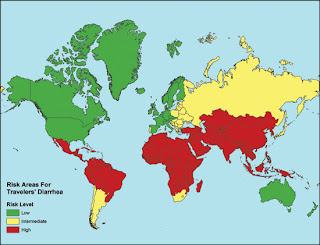
The Center for Disease Control discusses the science behind traveler's diarrhea, and the implication is that the traveler should be wary, but not the local. They also include an unsurprising map:
Focusing on travel diarrhea implies that its a travel issue, that in fact locals are able to adapt to non-potable water.  However, UN Millennium Development Goal #7, ensure environmental sustainability, includes a stated goal to reduce by half the number of people living without sustainable access to clean drinking water.  

The World Health Organization notes some interesting H2O statistics in a fact file:

- 4 in 10 people globally live without access to clean drinking water.  This is "getting worse because of population growth,  urbanization and an increase in domestic and industrial use."
-By 2025, 2 billion people will live with a water shortage. 
- The WHO recommends a level of 500 cubic metres of water per person per year, for healthy and hygienic living.
- Water scarcity means people rely on unsafe sources of drinking water.
- "Poor water quality can increase the risk of diarrhoeal diseases including cholera, thyphoid fever, salmonellosis, other gastrointestinal viruses, and dysentery.  Water scarcity may also lead to diseases such as trachnoma, plague and typhus.  Trachnoma, for example, is strongly related to a lack of water for regular face washing."
- "Water scarcity encourages people to store water in their homes.  This can increase the risk of household water contamination and provide breeding grounds for mosquitoes - which are vectors for dengue, dengue haemorrhagic fever, and malaria and other diseases."
- Good water management reduces breeding sites for disease vectors, reducing disease.

So to answer some of my earlier questions, no, I can't drink the water there.  People who come to the US don't face issues with our water, despite what the government of San Jose is having difficulty realizing.  Locals really shouldn't drink the water there either, but they have to.   There is no immunity, it does hold back the Global South, and something can be done.  However, there is not enough water to go around, so it will become increasingly difficult to keep what we do have clean.  

The answers raise an important new question: how do you live and care for your family without clean drinking water?

Friday, December 28, 2007

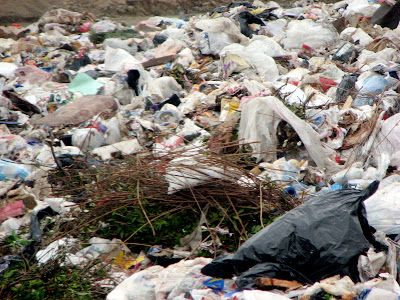
Visited the Dump Today

My friends were taking stuff to the dump today, and I decided to tag along. I had piled up some stuff thinking I'd use it again some day, but after months and years I realized it was time to clear it out. I felt guilty at first because it seemed wasteful and I hate the idea of sending things to a landfill, but then I realized that wasn't a good reason to turn my house into a landfill either. Next time, I'll try to buy stuff that will last longer - for example, we tossed out a mop without a removable mop head. A smarter purchase would have let us reuse most of it.

Anyway, it was a great chance to see what happens to stuff when we're done with it. Apparently, photography isn't allowed at the public dump, so I have blurred out a lot of identifiable information about which dump it is and so on.

Here are my three favorites:


If you want to see more of my illicit dump photography, check out my album.
At the Dump

Tuesday, December 18, 2007

The Relationship Between the Core and Periphery

I was talking to Drs. Reckmeyer and Fried the other night about the gap between the core and periphery countries. One of the things Reck always says is that we need to close the gap between the two groups for humanitarian and security reasons. Dr. Fried pointed out that in any arrangement, the core needs the periphery to be more inventive, while the periphery needs the core to hold on to traditional approaches, so that there can be realistic give and take between change and stability.

So, I was reading the internet like my grandfather must have read his morning newspaper when I came across this essay about how to improve Manila by Patricia Faustino.

I thought this was a really great thing. The World Bank had an essay contest about improving a city. Local people responded with great ideas. These ideas are on the internet for me, and presumably for the agents in the Philippines with the power to make a difference, to think about. Maybe knowing the international community is listening to these ideas will further affect them.

But more than that, I think Faustino's essay connects to what we were talking about the other night. And what Hash wrote about here in response to an article saying Africans don't need or deserve computers. His response to the rest of his community was, "Try this on for size: as an African, you are more of an expert on what your part of Africa needs than any self-prescribed expert from the west." Bill Thompson even wrote a thoughtful response, agreeing with Hash about the need for Africans to speak for Africa.

Its not just that peripheral solutions are better for peripheral problems because its a convenient way of avoiding personal responsibility. Certainly, I don't have the tools or the experience to know what a child in southeast Asia or sub-Saharan Africa needs or wants. But its not like we're all so different that if it came down to it, I couldn't come up with some ideas, however culturally inappropriate.

Really, they're better because they demonstrate who is responsible for the community. If a western construction crew showed up and built everything before Faustino had a chance to imagine it, it would be very unsatisfying. Winning a World Bank essay contest is far more fulfilling to the individual and community. Had the construction crew simply showed up, no one would have bought into the idea of public space, which would have then perhaps been destroyed. And, it would have pissed off well-intentioned donors in the west. Faustino's point about how important it is for citizens of Manila to imagine a better world is really well put.

Moreover, the core needs these frontier ideas in and of themselves. Not for humanitarian reasons or to empower the voiceless, but for the genuine betterment of everyone. These problems challenge core communities to put their best efforts towards something other than stagnation and decadence.

Wednesday, December 12, 2007

Nobel Lecture - Doris Lessing

Doris Lessing's Nobel Lecture was beautiful and important. There is really nothing to add.

Sunday, December 9, 2007

A New Kind of Toilets Help Malawi

These are pretty cool. They're toilets deisgned to convert human waste into compost. They're designed for hygenic practice, environmental soundness and resource preservation. Further, the authors note the technology is appropriate in Malawi because people will occasionally plant trees on former pit latrines. It is gaining popularity in Malawi and in Madagascar, although the authors are careful to note that their product does not suit everybody. But I think these will come in handy - maybe they'll think about building them at schools, since we always hear about how schools need toilets so girls can attend without getting sick.

Saturday, December 8, 2007

Beyond the Headless Heart: Accepting Complexity

I'm reading The Bottom Billion by Paul Collier. I wanted to share the following bit for two reasons.  First, I'm excited that more smart people are on board with the whole complex, systemic issue thing.  Its all well and good for me to parrot that; in fact its really important since I hope that through discussion and understanding we can put pressure on politicians to get to working on these issues the right way.  But like we need to understand that it's complicated, we also need to know what to do about it.  And that's really where professors from Oxford and the like can do their part.

The passage (and book) also contradicts one of Dr. Reckmeyer's big points.  He asserts that by assisting the developing core, like China and India first, we'll all be in a better position to assist everyone else.  Collier points out (slightly earlier in the book) that the global market is becoming too hostile for that to be a good idea.  So, we have some spark for a discussion.  

So here goes:

Beyond the Headless Heart: Accepting Complexity

The problem of the bottom billion is serious, but fixable. it is much less daunting than the dramatic problems that were overcome in the twentieth century; disease, fascism, and communism. But like most serious problems, it is complicated. Change is going to have to come from within the societies of the bottom billion, but our own policies could make these efforts more likely to succeed, and so more likely to be undertaken.

We will need a range of policy instruments to encourage the countries of the bottom billion to take steps toward change. To date we have used these instruments badly, so there is a considerable scope for improvement. The main challenge is not that these policy tools span various government agencies, which are not always inclined to cooperate. Traditionally, the development as been assigned to aid agencies, which are low in almost every government's pecking order. The U.S. Department of Defense is not going to take advice from that country's Agency for International Development. The British Department of Trade and Industry is not going to listen to the Department for International Development. To make a development policy coherent will require what is termed a "whole-of-government" approach. To get this degree of coordination requires heads of government to focus on the problem. And because success depends on more than just what the United States or any other nation does on its own, it will require joint action across major governments.

The only forum where heads of the major governments routinely meet is the G8. Addressing the problem of the bottom billion is an ideal topic for the G8, but it means using the full range of available policies and so going beyond the Gleneagles agenda of 2005, which was a pledge to double aid programs. Africa is already back on the G8 meeting in Germany. "Africa+" should rightly stay on the G8 agenda until the bottom billion are decisively freed from the development traps. This book sends out an agenda for the G8 that would be effective (pp. 12-13).